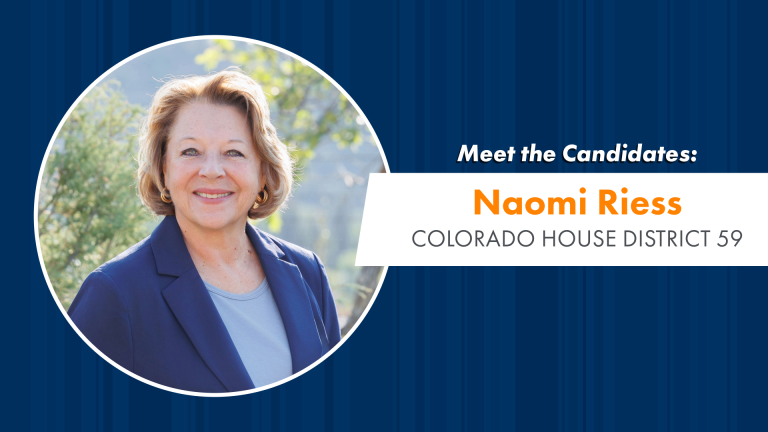
Naomi Riess, a Republican, is running for Colorado House District 59 against Katie Stewart, the Democratic incumbent. Watch Naomi Riess’s full interview, then see Katie Stewart’s interview here.
Watch more interviews and election content at LNN.news/elections
Learn More
Website: riessforcolorado.com
Facebook: www.facebook.com/797091586819730?ref=embed_page
Transcript
Hi, my name is Naomi Riess, and I’m running for Colorado House District 59. Well I’m running for House District 59, because I feel strongly that Southwest Colorado needs a much stronger voice in Denver. Someone who really understands that the decisions made at the state Capitol have real consequences for people who live and work here. I’ve lived here in southwest Colorado for more than 35 years. I’ve built small businesses here, worked with property owners, developers and local governments, and served the community through boards, commissions, agriculture, water, historic preservation, youth programs and health-related programs. That and that experience has taught me that good policy starts with listening to the people who actually have to live with the consequences, and understanding the history and the geography of our region matters. And that’s not something that the state House in Denver seems to take into account all the time. So it’s also shown me that government doesn’t always need to do more. Sometimes it needs to remove barriers and just get out of the way so people and businesses can succeed. And I feel really strongly about that. Being able to bring that perspective is so important to me. I’ve worked quite a bit with my local planning group, for example. So I really understand the realities of living in a rural area outside the municipalities. The thing that we look at, most importantly is talking about irrigation and domestic water. So the land use and planning side of it is very extensive. It’s what I’ve been doing all along. I work with a whole different, you know, all different kinds of stakeholders to solve problems in the land use arena. I’ve served on boards and commissions. I’ve been on the Historic Preservation Commission for 15 years. I’m the vice chair. I own a small farm, I irrigate, I have water rights. I understand how important agriculture and water is to our entire community. I’ve worked on all different kinds of water projects. My volunteer and community leadership experience is pretty extensive. I’ve been a 4-H leader. I’m a master gardener. I have mediation experience. During the downturn of the real estate market, I started mediating and specializing in divorce with children and helping parents create communicative, cooperative co-parenting plans that were going to survive their child’s childhood looking for practical solutions with people who really don’t like each other and don’t even want to talk to each other or be in the same room. So I’m, I, I like to look for solutions. I like to listen to the alternatives. I look at what isn’t working. I try to understand why, and I try to figure out what is the best solution for the people involved. My main priority is what I’m hearing constantly here. It’s affordability and opportunity. And so it varies a little bit depending on which part of the district I’m talking to people in. But basically it comes down to affordability, affordability, affordability, if people can’t afford to live here, then businesses can’t find workers. Kids can’t live where they grew up, businesses can’t grow. And if people are spending most of their income just keeping a roof over their head, it becomes much harder to build a strong, healthy community when there’s nothing left over to pay for gas or food. So I would start with housing. That has to be where we start. It’s not necessarily something that’s going to change overnight. So I would try to look for solutions that could be implemented faster and then more of a long-term, long-range planning solutions as well. I would definitely focus on making it easier for private enterprise to build attainable priced housing. We have we have passed a lot of affordable housing bills over the last few years. And I’ve come to the conclusion, after really looking at those bills and thinking about how they’re going to play out in the ground, that, first of all, government is not going to build its way. It’s not going to legislate its way out of this housing shortage, the housing crisis. So we just need more housing, period. And most importantly, we need to get private enterprise to step into that shortage.