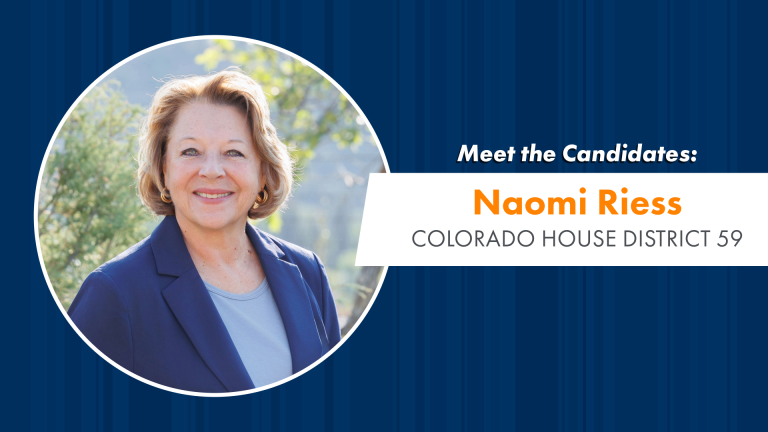
Katie Stewart, the Democratic incumbent for Colorado House District 59, is running for reelection against Naomi Riess, a Republican. Watch Katie Stewart’s full interview, then see Naomi Riess’s interview here.
Watch more interviews and election content at LNN.news/elections
Learn More
Website: www.katieforcolorado.com
Transcript
Hi, my name is Katie Stewart. I’m running for House District 59, which encompasses La Plata, Archuleta, San Juan, and most of Montezuma counties. I am seeking this office because my family has a long history of roots in this corner of the state, and a large part of it, as cliche as it may sound, is for my kids. I want to work to ensure that they’ll be able to live in Southwest Colorado if they so choose, and and have the lives that they they want and work for. And that applies for everybody in Southwest Colorado. That’s that’s why I want this job, is to continue to do the work at the Capitol in hopes that, you know, every day we make things a little bit better. I have a wide variety of experience in non-profit work, in healthcare and being the parent of five kids. So a lot of lived experience that makes it unique for me to be at the Capitol. I think the thing I hear about the most from constituents really is affordability. As you know, grocery prices increase, gas prices increase, healthcare costs increase. Healthcare costs are growing at 12 to 15% per year, sometimes as high as 19% per year. We’re staring down the barrel of increasing premiums in Colorado. And so my work has largely been around affordability and access to healthcare. And I’d like to continue that work because it’s so important. I would say that there’s not really a specific bill that can answer the affordability issue. It would be a combination of bills to impact that, you know, such as access to affordable childcare or just childcare in the first place. It’s a large economic driver here in southwest Colorado. You know, I recently learned in the last few months that La Plata County loses out on $34 million a year because of the lack of childcare spaces and affordable, affordable childcare spaces in Southwest Colorado. So, you know, working on that component, which I’ve done through the use of the Lodgers Tax, I worked on that with Commissioner Matt Sulkin. In 2025, I have worked with Commissioner Warren Brown in Archuleta County and Commissioner Matt here in La Plata County and Emily Lashbrooke over in Archuleta County on Prop one, two, three, which is a statewide affordable homeownership program. And we work to change, that statute. So Southwest Colorado and mountain resort rural communities could draw down more dollars. I’ve worked on a variety of healthcare bills that make sure people can get treatment in the appropriate place, so they’re not paying large bills. So there’s a host of work that I’ve done in the legislature over the last two years that I’ll continue to do as we work on this piecemeal. A specific decision I made that I would do differently. I think there’s quite a few to choose from. I wouldn’t say that there are any votes I would change, whether it be from my time in the legislature or on the Durango School board. But I would say I’ve learned so much over the last 5 or 6 years in crafting policy and how to engage in that, and I learn every day in the Capitol. And I would say, if you’re not learning, you’re not growing. So when I learn to do better, I try to apply that in the work that I do and in my everyday life. Looking back five years at policy, I, I think you know what, in the legislature, what we need to be better about is evaluating how policies are impacting folks across Colorado, especially in rural Colorado. Our counties seem to be disproportionately impacted by mandates that come out of the state legislature. So having that ability and willingness to re-examine policy that we’ve passed and, you know, what can we do to improve that? Go, you know, that goes back to learning and doing better. I would say I would have to go back further than the last five years. You know, Tabor, the taxpayer Bill of rights, which was passed in 1992. I know that there are a lot of folks out there that are big fans of having a say in where their tax dollars go, and I honor that. But the implications over the last almost 35 years have been quite devastating at times for Colorado. So re-examining that policy and and its implications are really important and something that I wish, if, you know, if I had a time machine, I’d go back and talk to folks in 1992 and and tell them, you know what the state of Colorado is now facing because of the passage of that constitutional amendment, something that I would defend is definitely what we passed in 2024, which is a constitutional right to an abortion in the state of Colorado. Reproductive healthcare is a top priority of mine. And in Colorado, we need to ensure that it stays right. It impacts women’s healthcare in such a large way. And a right to an abortion is not necessarily a you know about. Somebody making a difficult decision. That’s oftentimes it needs to be it is about what that person needs because their health is failing or it is not a viable fetus and pregnancy. And so we need to make sure that that women have that access to this necessary healthcare and abortion and reproductive healthcare is absolutely necessary. I do believe that we need to look at the implication of the taxpayer’s Bill of rights and, you know, not necessarily rolling that back completely, but is there an option to reform that so we can better provide for the citizens of Colorado, you know, the everyday folks, to make sure that they can live in these beautiful communities in which they work. So how has Tabor and its revenue constraints impacted affordable housing, childcare, healthcare, K-12 education, higher education? All of this is intertwined. And so looking at that broader picture of the revenue streams of Colorado and the impacts of our our population is really important. And, you know, my office, I think there are a variety of ways to do that. There are 100 of us in the legislature and there’s enough work to go around, or we all take a crack at that and through a variety of bills. So working in collaboration, not just within my party but across the aisle, especially given the district that HD 59 is, is extremely important. Working in politics is oftentimes stressful. Absolutely. I would say spending time with family and friends is really important. I try to squeeze that in as much as possible. I still have young kids at home, but I would say one of my favorite things to do is go to the Durango Hot Springs.