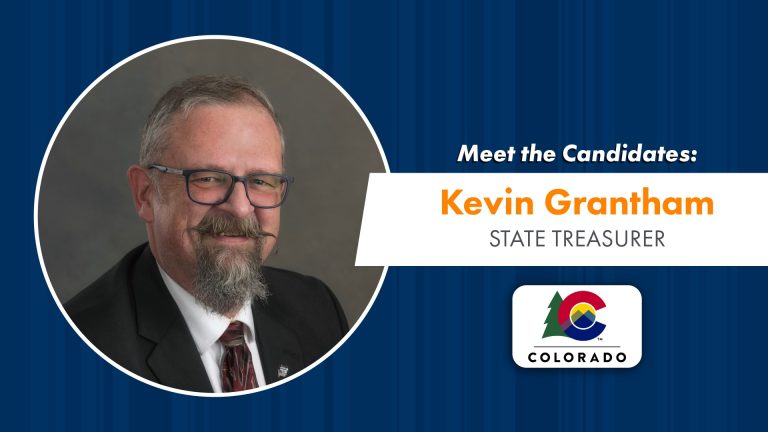
Kevin Grantham, a Republican, is running for state treasurer against Jeff Bridges, a Democrat.
Watch Kevin Grantham’s full interview, then see Jeff Bridges’s interview.
Watch more interviews and election content at LNN.news/elections
Learn More
Website: citizensforkevingrantham.com
Transcript
Hi, my name is Kevin Grantham and I am running for Colorado State Treasurer. Well, I grew up in Southeast Colorado, in Ordway, Crowley County, so rural Colorado. I was actually a hog farmer growing up of all things. So I certainly do have a little bit of experience when it comes to the rural life and farming and ranching. Oddly enough, I received my degree in religion from Liberty University. I am a real estate agent, a real estate broker, and a real estate appraiser specializing commercial real estate. So that’s part of my experience and perspective that I bring into this endeavor. Of course, living in Canyon City, so still out in rural Colorado, living in Fremont County, and I’m a husband and a father and a grandfather of five, and I have representation experience with the people of Canyon City and Fremont County, going back to days on city council and the state Senate, and now as a commissioner. So I have certainly experience as far as representing folks and as well as in the private sector. So I guess to answer your question, my my role, upbringing and small business background, certainly coupled with that local and state government experience I think suits me to being the chief steward of the dollars that are entrusted to the state Treasury. On behalf of all of the taxpayers of Colorado, those hardworking folks. And I bring an understanding, of course, what it’s required a small business and what it takes to thrive in Colorado. And unfortunately, lately, what it takes to survive in Colorado. I bring an understanding, certainly on the local level, when it comes to the my representation of the people and effectively spending and stewarding their hard earned dollars. Certainly, at least in my current role, as how it relates to plowing roads and filling potholes, the things that matter, certainly on a daily basis to the folks of Fremont County currently. And I think from my state experience, I bring an understanding of the leadership that it takes to guide policy and the fiscal responsibility necessary to manage a large office to the betterment of the Coloradans that I represent and what they need and what they deserve. So, you know, there are a whole lot of little roles that the Treasurer’s office does entail. You know, on the daily basis, there’s not the pothole filling role that the that the Treasurer has, like the, the Commissioner or City Councilman has. But the one thing that the Treasurer does that can affect the I would I hesitate to say the day to day life, but it can certainly affect the individuals in a, in a, in a maybe indirect way. But the Treasurer has a fantastic platform and a bully pulpit to be able to address problems in State Government, to be able to address fiscal mismanagement, maybe bad policy that will negatively affect the taxpayers. That bully pulpit is effective only when the the Treasurer is actually vocal and is actually standing up and being a vocal advocate for Coloradans that are struggling right now through an affordability crisis. This is a tool that the Treasurer can use to push back on, like I said, bad fiscal policy, like tax increases when more more money is being required of the taxpayers, and more and more every single election, things that exacerbate the problems that the taxpayers are already going through. And and also on the on the flip side, to support sound fiscal policy as it happens, that will obviously benefit the the hard, hard working taxpayers of Colorado. And so I think that’s probably the number one thing being that being that advocate sometimes against the legislature and the governor and sometimes alongside the legislature and governor, but they have to be also independent of those two bodies in order to be effective. Well, I think going along with what I just mentioned, as far as you know, being that advocate for the people of Colorado, you know, as far as the role of being the chief investment officer for the people of Colorado, my main priority would be to maximize those taxpayer dollars in the state investments portfolio, the TPOOL investments, and and in other ways. But again, to be that, vocal advocate for Colorado families struggling through the affordability crisis that all of that under that umbrella of maximizing the taxpayer dollars in the safe, reliable way that has historically been the role of the state treasurer to the benefit of the Colorado taxpayer. You know that’s an interesting, interesting question because I, I, you know, you look back on your career and you think, okay, where is that one thing that, that one seminal moment where you’re looking at this changed. And, and I got to be honest, when I’m looking at, my career as a representative of the people of Canyon City, of the people of Senate District two at the time, and now the people of Fremont County. You know, there’s no specific vote that I look back on and go, oh, I regret that. You know, I wish I had done something different. I don’t have one of those moments, but what I when you ask, you know, what would you do differently today? There are things that that I do differently now as I age in my representative. Representative life in certainly in my youth as a city councilman and and even as a Senator, you know, you you approach things more stridently, you approach things with more. I’m always right. You’re always wrong kind of attitude. And I think a little bit more experienced, I get a little bit more seasoned is a kind way of putting it to myself. The more seasoned you get, the more you’re willing to to bring in all sides. It may not change your decision, but how you approach things also can help soften the stride and see can help smooth out rough edges and and achieve some consensus because of how you approach things. So if I look at things that have changed over the course of my career as a representative of the people, it would be how I approach things and how I achieve agreement or consensus, even if it didn’t change the ultimate outcome of how I voted on something. Certainly my approach to how I got there has changed. I think probably one of the most critical things that we see happening in Colorado, and this is especially over the last couple of years in regard to the state budget, we have seen at least since Covid, never increasing. Over commitment of of declining revenues. When I say declining revenues, I mean at least the declining rate of increase of revenues, we saw the creation of some year over year costs that were initiated through one time money. That is something that was done on the state level that most folks, at least at the county and city levels that received that kind of ARPA money were very. Worked, very hard to avoid creating ongoing expenses with one time money. It’s a dangerous thing to do. And the state did exactly that. This has created these constant budget crises that we’re currently plagued by. This is going to have to be addressed and not without paying. And it’s going to take some tough decisions at some point for this legislature and the next Governor to to be able to bring this back under control. That’s just on the budget side. The Treasurer doesn’t have something directly to do with that, except for what I mentioned before, the bully pulpit, the Treasurer can stand and say, this is what you need to do for the people of Colorado. And and here in this specific situation, here’s what needs to be addressed. And the Treasurer must take that role seriously. On another note, one thing that the Treasurer does have some influence over directly is the Unclaimed Property Trust Fund that is used in budget balancing. But it’s not tax dollars that is used to fund government operations. Those are dollars that are entrusted to the Treasury and to the Treasurer. For the treasurer to find the true owners of that dollar. But it is not tax dollars to be used to balance the budget, but unfortunately it has been used in that fashion. The Treasurer needs to be a stronger advocate for the owner of owners of those monies and prevent as best he is able, or she is able to prevent the the spending of those dollars to balance the budget. That’s not what they’re there for. In fact, it’s quasi legal to to take those. The legislature gets to take those dollars because they declare it to be legal. But the fact of the matter is, I don’t think it is. It’s not their dollar and they are spending it. It’s not there to fund government. It’s entrusted to the Treasury. So those are the two main things budget and budget. I think that’s a wonderful question. I think it’s an underrated part of the Treasury’s, the Treasury’s role of the Treasurer’s role, specifically as a board member for PERA, obviously 69%, that current funding number is not adequate, but that number alone by itself doesn’t, of course, tell the whole story of where PERA has been or where it is or where is it going. It’s certainly an improvement over where it has been recently, and we must acknowledge that because it was down in the 50s as far as its overall funding as recently as I think 2018 or so, but it’s up to 69%. And we should acknowledge the fact that it’s heading in the right direction. But we should also acknowledge the fact of how it got into the right direction. That’s due to the reforms that we actually passed back in 2018, when I was Senate President at the time, and I was instrumental in helping the legislature, legislators put that bill together and get it through the chambers. And we have to continue the implementation of Senate Bill 200. It reformed PERA. It set us back on the path for solvency. The that legislation vastly improved the funding of the pension. But we’re only partway there. We’re only, you know, eight years into this plan of a 30 year plan, sort of like our mortgage. We we took out a mortgage on this unfunded liability that we have in PERA, and we are on schedule to get that paid back in 2048. And when I say paid back, I mean fully funded. So that’s something we have to take seriously. I think the treasure has a board member should advocate for sticking to the plan to get us back to square one, because we owe that to our state employees. We owe that to our current retirees to make sure that we have a pension that is funded so that in their retirement and their ongoing retirement, that they actually have a pension check coming in, and not only to them, but to our current employees, because it is our current employees that are actually footing a bigger portion of the bill. Now to help the current retirees make sure they have a pension. And so this is a promise that is given to the current pensioners. It’s a promise given to the current employees, and it’s a commitment that we have to make to our future employees that this pension will be solvent over the course of the next few decades, if not into infinity, at least as long as we still exist here as a state and have a pension system, we owe that to them. And we have to make good on that. And the best way to do that is to stick to the plan and make sure we don’t go fiddling with the numbers. Now, it was it was just not so long ago where the legislature, I think it was 2020 or 2021, reneged on part of that plan. And they they paid some of it back because this is going to. Too much detail. Possibly. But I was there when all this happened. And so when we when we look at the overall plan, we in order to get back to solvency, we actually had to get both sides of the coin to, to pitch in. And when I mean both sides of the coin, I mean the, the state employees are are giving more on their contribution side out of their paychecks. But on the other side, the taxpayers also had to kick in order to eventually get us in 2048 back up to solvency. And what the legislature did is they said, well, the state’s not going to pay this year to the tune of like $225 million. That’s a direct cash infusion from the taxpayers. That cannot happen that fiddles with the numbers. And we have to continue paying our part as long as the employees have to pay their part. And both those things happening means that we get back to solvency. And with any luck, with good return numbers on the investments, then maybe we get there quicker. But if we get the typical rates of return, you stick to the plan, make it to 2048, get to solvency. Well, driving around this state and this is nothing new. Of course, but it’s something I’ve experienced for a long time. We have to get our transportation system back, in line. We have to get our highways rebuilt. Our highway system is arguably one of the worst in the nation. All you have to do is drive from any of our neighboring states, and you cross the state line. And there’s a you know, when you pass into Colorado, the the roads are in horrible shape. It’s it’s an expensive proposition. Our state, over the course of the last 2 or 3 decades, has decidedly moved in a different direction with the prioritization of its money. I think it is fallen down on the job, and it’s going to be an expensive proposition to get back in order. And it may take us a couple of decades to to get where our highways are looked at, even on the same level as our neighboring states. It will be expensive, and we will have to probably go to the vote of the people to bond a whole lot of money in order to get those highways fixed. And I’m talking about more than just expansion of choke points like I-70 going up into the mountains. Something does have to be done there. But I am talking about the repair, if not the complete rebuild of some highways out on the eastern plains, major truck thoroughfares that are vital for our our commerce and our interstate commerce system. Highway 287, highway 385. Highway 350, highway 10. And that’s mostly just southeast Colorado. That doesn’t even get into a lot of the other portions of northeast Colorado with I-76. I-76 is probably one of the worst interstate portions in the entire world or country. I would say transportation is the number one thing that’s going to be the big, painful pill that we have to swallow here very soon. Because they are falling apart and there’s no foreseeable end in sight under our current direction. That is that is going to fix it, and we have to take care of it. That’s a great question. I enjoy just sitting in the quiet with with my wife and watching TV, have a nice fire pit on the backyard. And I enjoy those quiet moments and time with the grandkids. I tell people all the time, if you have a you have the opportunity, you have the choice. You can start with grandkids. There’s just so much better than kids. But I totally enjoy my time with them. And that’s how I de-stress at home. When I have the time, I like to go out and hit the golf balls to. That’s that’s always a fun time. I shouldn’t say always a fun time. Sometimes it’s really not. But that’s more my fault and how I play.