Our Shared Currents is a 3-part series exploring human relationships along Southwest Colorado’s waterways. These stories of unexpected commonalities go beyond traditional boundaries and competing demands. In this first episode, we learn how water systems and local wildlife connect the Rio Grande and Colorado River basins. The San Juan-Chama Project, a major transmountain diversion originating in the South San Juans and funneling water underneath the Continental Divide, is a critical lifeline for communities in New Mexico. People and nature are uniquely bound together across the Divide by these shared waters.
This story is supported by the Greater Good Science Center and Colorado News Collaborative.
Transcript
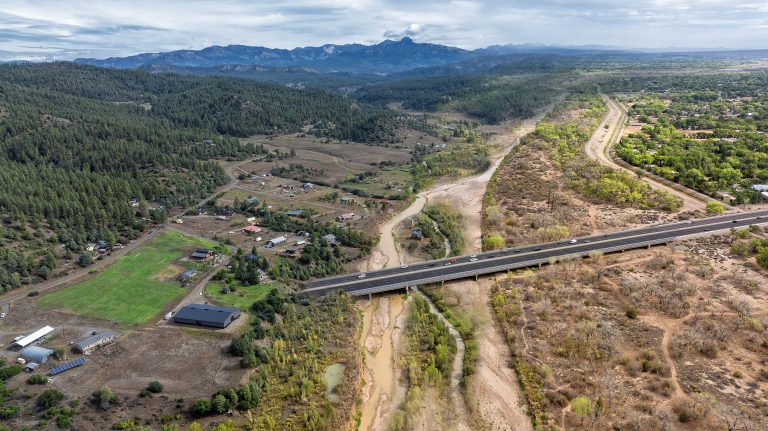
My concerns for the future all are focused around the issues of a warming and drying world. It’s a tough problem. This isn’t a problem that has an easy answer to it. We’re all part of this. And, there aren’t hard line boundaries. The Rio Blanco Valley is located about 12 miles south of Pagosa Springs, Colorado. The river itself carries water that is captured during the winter, primarily as snowfall in the San Juan Mountains that surround us, and is part of the San Juan River watershed, which feeds into the Colorado River. When I moved to this valley, I learned that the the Rio Blanco watershed is significant to communities far south from here. In the 1960s, a diversion was put in place that diverts water from the Rio Blanco, the Little Navajo River and the Navajo River to our south through a system of underground tunnels and some surface canals. That water then is transferred to communities in New Mexico, including Santa Fe, Los Alamos and in particular, Albuquerque. The San Juan-Chama, it’s been a real lifeline for the Rio Grande as a project and providing additional water resources that are direly needed. It is Colorado River water coming into the Rio Grande basin. It was primarily developed for our cities for drinking water. It’s also been used since then for assisting with irrigation for farmers, and also for wildlife purposes. The corridor really from Santa Fe down to Socorro and south is a corridor of cottonwood galleries. It is the largest cottonwood gallery, I believe, on the planet. The bosque through the Rio Grande in central New Mexico is home to an estimated 400 plus species of birds. So this includes birds that come to nest here in the springtime. And then also the winter birds are really remarkable. In Albuquerque, like where we are today, we’re really basically in the middle of the city, and it feels like we’re in a wild place. Lots of people use it. It’s a real refuge for our communities. Certainly I have concerns for the natural ecosystems here and the biological communities that we all enjoy observing, the bird community in particular. We have over 100 species that are present here that most of us would not even know are present. There may be only 8 or 10 that we see commonly. Most of those species, in particular those that migrate long distances to come here to breed and reproduce, are declining. And certainly the condition of our forests impacts the ability of those birds to reproduce. One of the impacts of this extended drought that we’re going to see happen cumulatively over the next several years is tree death. It’s likely to occur because of infestation of budworms and bark beetles. So there are higher order impacts of this extended drought that we don’t necessarily think about. But when you look at it from an ecosystem perspective, these are important to foresters and residents as well. This year is 2026, and the allocations for the San Juan-Chama water for New Mexico have been around 26 to 30%. So it’s the lowest allocation on record. With no snowpack and warmer temperatures, we’ve seen the river the driest that it’s ever been in my lifetime. This has been a hard year for the cottonwood forest through Albuquerque, one that probably is going to die back 30, 40, 50% of the trees. And the impacts have also been seen in the wildlife. If you go to the dry parts of the river, it’s very quiet. You don’t hear birds. It’s like this sort of eerie silence. Once you’re at a place where there is flowing water, things sort of pick up again. You hear the bird calls and it feels much more alive. I return to New Mexico every year to do nature and wildlife photography. So I feel a kindred relationship with the landscape. It always impresses me, the beauty of the wildlife, like the sandhill cranes and snow geese and other migrating waterfowl and upland birds that pass through the Rio Grande Valley. And I’m glad that the watershed I live in can provide them some sustenance through the water that our landscape captures and sends their way. To learn more about the San Juan-Chama watershed, visit sanjuanchama.org. And for more stories like this, visit lnn.news.